Archive for August, 2026

SBV, an unusual game codec

Monday, August 24th, 2026

While I’m still preparing next na_game_tool release (still a couple of codecs to RE and implement!), I’ve finally encountered a very rare beast—wavelet game video codec!

Gunmetal features SBV format with the minimum header (frame table contains just timestamps and start offsets) but each of those frames is coded using fast wavelet coding algorithm. First level is transmitted as byte values, the other levels are coded in 4×4 or 8×8 blocks, one level after another, using fixed-bits non-zero coefficient coding (the number of bits depends on the block coding mode) plus some bit flags to code zero runs. (De)quantisation is done by simple shift operation. Wavelet looks like the traditional LGT 5/3.

One might think the scheme is truly scalable but unfortunately you have to decode data for one plane before you move to another. Speaking of planes it’s a simplified YUV-like scheme with
Y = ( R + G + B) / 3
Cr = (2R - G - B) / 3,
Cb = (2B - R - G) / 3

with the traditional 4:2:0 sub-sampling.

This could’ve been a simple intermediate video codec for the cases where you’re really strapped for CPU power but still want some compression. And yet it’s a game format instead… I’m still delighted to encounter such format in a game (and in general).

Again on Knowledge Adventure MOV

Friday, August 14th, 2026

While I have time I’m preparing the next release of na_game_tool, which involves REing formats (of course!). And among the formats I want to add is Knowledge Adventure MOV. So I’ve revisited it and RE’d one of the flavours.

Apparently there are three versions of that MOV: the original format used in DOS games (with magic KAMv), version 2 (starting with LzH2) and version 3 (starting with LzH3) which seem to be used in both DOS games and some Internet applications (and I’ve used Mac binary for Undersea Adventure). So while I’m yet to progress on KAMv (because there’s only 16-bit DOS binary specification for it), I’ve mostly REd LzH2 and it’s rather crazy.

This codec splits image into rows of 4×2 tiles and unless I’m mistaken those rows are coded in scalable way (first just one row, then two, then four, then eight and so on until the whole frame is decoded). Each tile may be coded as motion (with a set of motion vectors selectable in the file header—it gives me flashbacks of DiVX 3 Hi/Lo-motion), raw tiles, or pattern-coded tiles. And those pattern-coded tiles actually may code colours explicitly or use another motion vector to re-use some existing ones, that’s not something I’ve seen before. Afterwards all those kinds of data (tile types, colours, patterns, motion vector indices) are grouped and compressed with their own static Huffman codes; the tree descriptions (just code lengths as the symbols are always the same) are transmitted at the beginning of each frame.

Overall, it reminds me of Smacker if not for the fact it uses per-frame Huffman trees instead of global ones (and raw PCM instead of Huffman-compressed data), smaller tiles and more ingenious use of motion vectors. Now I want to implement a decoder for it even if just to see what I understand wrong.

Looking for a job (again)

Monday, August 10th, 2026

Pre script: I’ll try to keep this post above the rest for obvious reasons and you should find newer posts about the usual stuff below.

For circumstances out of our control I don’t have a job any more (after sixteen years of it) and I’m completely free starting from February next year. And while I can live more or less comfortably for a couple of years on my savings I consider proper to have a job, preferably an interesting one. Since it is hard to find an interesting job for my qualification, I post this in faint hope that somebody will offer me one.

First of all, let’s start with what I can do. I have a good knowledge of C (but not C++ — nobody knows C++ in its fullness, I just don’t lie about it), Rust and various assembly languages (not just x86/AMD64 and ARM, I have some experience with a couple of more exotic ones; most of the assembly code I wrote is SIMD optimisations). I also have a knack for reverse engineering things and documenting them afterwards, which involves nor merely looking at the decompiled output (or disassembly when a decompiler can’t handle it or lies) and copying it verbatim but rather understanding it and comparing various parts to the known methods. And of course I have vast knowledge of multimedia and adjacent technologies (up to OS and CPU architecture). What I don’t know I can learn.

Then, why you should consider hiring me. If you need somebody who can write safe, portable code or fast platform-dependent assembly code that will not need much maintenance afterwards. If you need somebody to work on low-level multimedia stuff (not just integrating an existing framework but messing with protocols and decoders directly) or related image/audio processing. Or if you need somebody to work on low-level stuff e.g. for embedded systems or microcontrollers. If you need somebody to debug complex cases or reverse engineer third-party stuff for interoperability (digital sovereignty is supposedly a thing now in the EU, maybe you need somebody to implement a part of it).

Last, working conditions. I’m a naturalised German citizen, so I’d prefer my work to be inside EU, preferably remote or close to Karlsruhe where I live; or at least not requiring a relocation to another country (which is still possible for EU but the offer must be very appealing). Additionally I prefer to work in a small company instead of being a cog in a large corporation. Finally, the unpleasant question of money: I’m not going to work for exposure, peanuts or partnering up for the future profits (I had enough of that in my student times, thanks); it should be enough for a decent living here i.e. what any other middle-class worker can afford and anything above that is nice but not mandatory.

If nothing works maybe I’ll just get some useful menial job instead.

Here’s my email (repeated for convenience as it’s hidden in the links way below):
Who knows, I might be more lucky this time.

A bit about Pälzisch Dialekt

Tuesday, August 4th, 2026

I semi-jokingly say that that Alsace deserves to be called Südpfalz since the cultural border there is not clear unlike the country borders. And I mentioned back in the day that a lot of places in central Rheinland-Pfalz (or Rheinland-Palatinate if you don’t recognise its proper name) sound even more French than those close to the border (no matter from which side—e.g. both have river Lauter and a town named after it, be it Lauterbourg or Lauterecken; and Hœrdt is on comparable distance from the border as Hördt). But recently I’ve seen something that made me even more suspicious about the influences.

There’s a small town not far from Mainz called Gau-Algesheim and it has rather peculiar variation of the local dialect. Here are two examples of it:

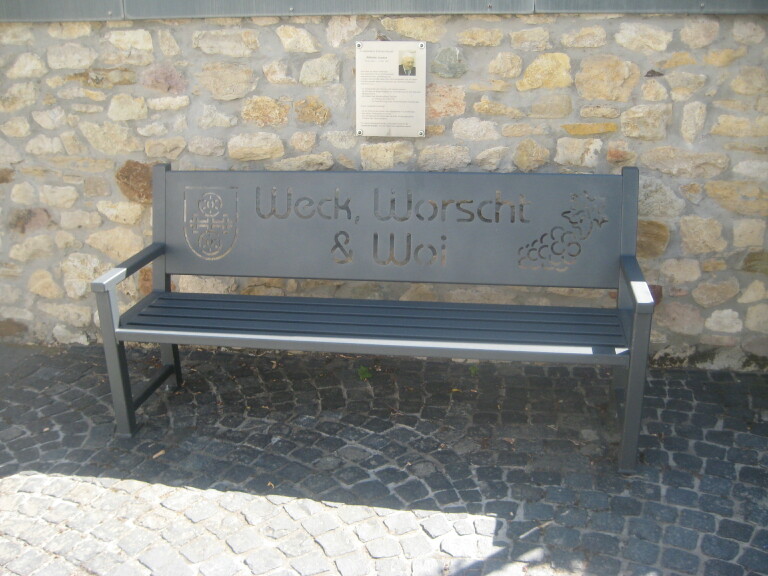
This is a bench installed in the town centre in the memory of one of its distinguished citizens. The words on that bench are “Weck, Worscht & Woi” which I believe map to the common German “WerkBrötchen, Wurst & Wein” (or “workbun, sausage and wine” auf Englisch). Side note: thanks for the commenter for the correction, I should’ve looked in the dictionary first.

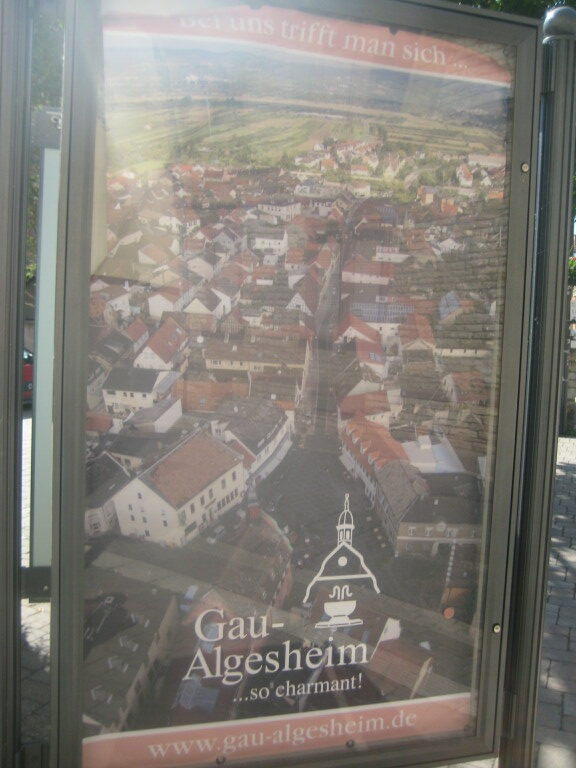
And this is one of the billboards you can encounter there. There are others, featuring other picturesque sights of the town like Graulturm, but the motto remains the same on all of them. I really have no idea what the words “so charmant” may mean in the local dialect but you cannot convince me that they don’t sound suspiciously French.

Hopefully I was able to demonstrate my point that there’s something fishy going there. I’ll keep investigating the mysteries of the land (here’s another example: the centre of local shoe industry was in Pirmasens and yet the museum dedicated to it is located in Hauenstein instead—with a shoe stolen from Montabaur, which is a very long way from either of them), at least for my own amusement.